
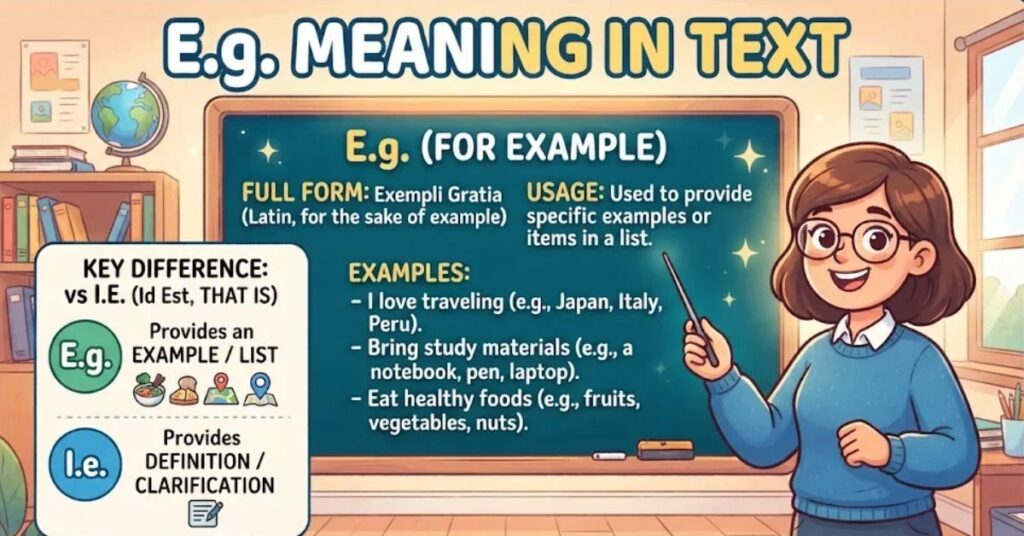
Have you ever received a message containing e.g. and wondered what those two little letters mean? You might see them in a text, Instagram comment, work email, or school assignment. Although the abbreviation looks complicated, its meaning is surprisingly simple. E.g. meaning refers to for example. People use it when they want to mention a few things that represent a larger group. It helps make messages shorter while giving readers useful details.
However, e.g. isn’t the only abbreviation that confuses people. You might also come across i.e., etc., and ex. These expressions look similar but serve different purposes. Understanding their meanings can help you write clearer messages and avoid common grammar mistakes. This guide explains their full forms, pronunciation, punctuation, everyday usage, and differences through practical examples. By the end, you’ll know exactly when and how to use e.g.
Quick Answer: What Does E.g. Meaning in Text?
E.g. means for example. People use this abbreviation in text messages, emails, social media posts, and formal documents to introduce one or more examples of something.
It comes from the Latin phrase exempli gratia, meaning for the sake of example.
For instance:
- Bring some snacks, e.g., chips or cookies.
- I enjoy outdoor activities, e.g., hiking and cycling.
- Please share your documents, e.g., your ID or passport.
In each sentence, e.g. introduces sample items rather than a complete list.
E.g. at a Glance
Here’s a quick overview of the abbreviation and its important details.
| Detail | Answer |
|---|---|
| Full form | Exempli gratia |
| Language | Latin |
| English meaning | For example |
| Pronunciation | E-G or for example |
| Common spelling | e.g. |
| Alternative spelling | eg |
| Typical usage | Introducing examples |
| Related abbreviation | i.e. |
| Writing style | Formal and informal |
Remember that e.g. introduces examples from a larger category. It doesn’t mean that the listed items are the only available choices.
What Is the Full Form of E.g.?
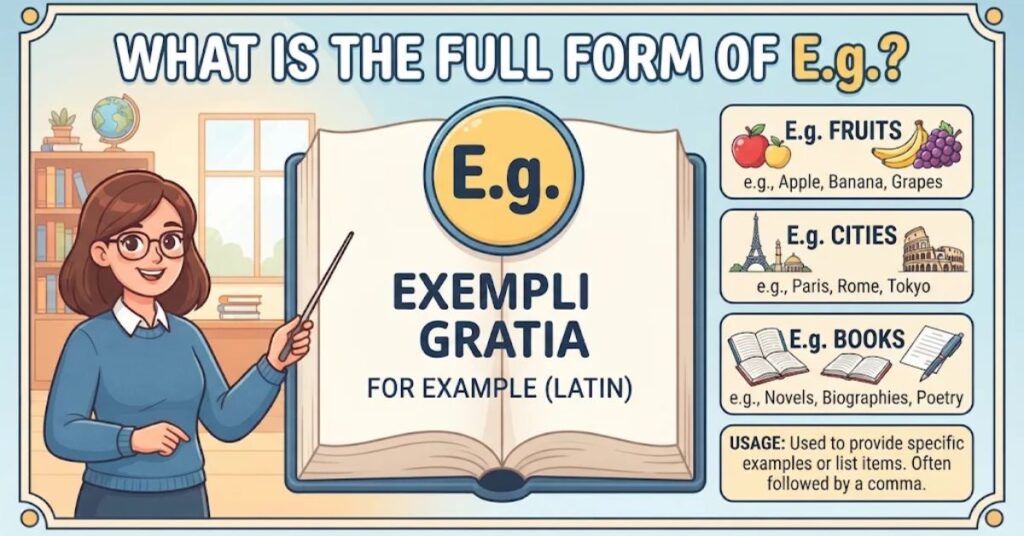
The full form of e.g. is exempli gratia, a Latin expression that means for the sake of example.
The abbreviation takes its first letters from the two Latin words:
- Exempli: Of an example.
- Gratia: For the sake of.
English writers adopted this expression to introduce examples without writing the complete phrase every time.
Today, you’ll find e.g. in school assignments, business emails, research papers, instruction manuals, and everyday conversations. Most people don’t know its Latin origin, but they understand its meaning from context.
How Exempli Gratia Became E.g.
The abbreviation developed through a common writing practice: shortening longer Latin expressions by using their initial letters.
Writers kept the first letter of each word and added periods to create e.g. This compact form became popular in academic books, legal documents, dictionaries, and professional correspondence.
Eventually, it moved into everyday English communication.
Other familiar Latin abbreviations include:
- I.e.: Id est, meaning that is.
- Etc.: Et cetera, meaning and so on.
- Cf.: Confer, meaning compare.
- Viz.: Videlicet, meaning namely.
These expressions remain useful because they communicate specific ideas in fewer words.
How Do People Pronounce E.g.?
Most English speakers pronounce e.g. by saying the two letters separately: E and G.
Others simply say for example when reading a sentence aloud. Both approaches help listeners understand the intended meaning.
For instance, consider this sentence:
Bring something warm, e.g., a jacket or sweater.
When reading it aloud, you would normally say:
Bring something warm, for example, a jacket or sweater.
People rarely pronounce the original Latin expression in everyday conversations. Saying for example sounds more natural during presentations, meetings, and voice notes.
How Does E.g. Work in a Sentence?
E.g. introduces one or more examples that explain a broader category. It gives readers an idea of what you’re discussing without listing every possible option.
For example:
I enjoy reading different genres, e.g., mystery, romance, and science fiction.
Here, mystery, romance, and science fiction represent a few types of books. Other genres could also fit the category.
E.g. Introduces Samples, Not a Full List
One important rule separates e.g. from other abbreviations: it introduces examples rather than an exhaustive list.
Consider this sentence:
You can bring a drink, e.g., water or juice.
The sender mentions two drinks, but you could also bring lemonade, milk, or another suitable beverage.
This makes e.g. helpful when you want to offer suggestions without limiting someone’s choices.
E.g. Sits Right Before the Examples
Place e.g. immediately before the examples it introduces.
Correct:
- Choose a hobby, e.g., painting or gardening.
- Bring school supplies, e.g., notebooks and pens.
Incorrect:
- E.g., choose a hobby like painting.
- Choose painting e.g. as your hobby.
The abbreviation should connect the general category with its examples. Proper placement makes your sentence easier to understand.
Where E.g. Fits Best
You can use e.g. in different types of writing.
| Placement | Example |
|---|---|
| Inside parentheses | Pack healthy snacks (e.g., nuts or fruit). |
| After a comma | Try outdoor activities, e.g., hiking or cycling. |
| In a caption | Available formats (e.g., PDF, DOCX). |
| In a casual chat | Bring snacks eg chips or cookies. |
Parentheses are especially useful when examples provide additional information rather than the main point.
What Does E.g. Mean in Texting and Chat?
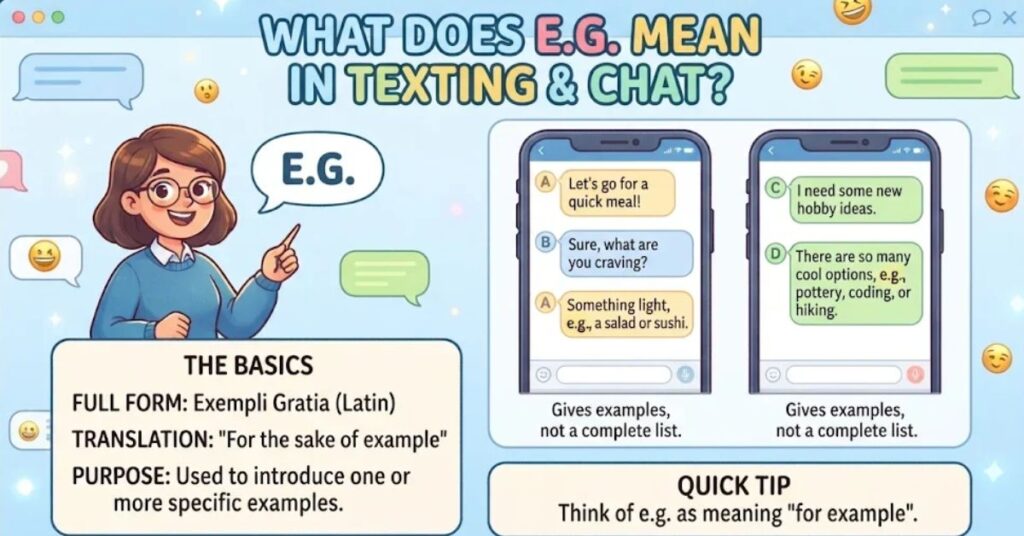
In texting, e.g. still means for example. Its definition doesn’t change when someone uses it on WhatsApp, Instagram, TikTok, or another messaging platform.
People use it to suggest options, explain preferences, and provide additional details.
For example:
Friend 1: What should we watch tonight?
Friend 2: Something funny, e.g., a comedy or animated movie.
The second friend gives two suggestions without restricting the available choices.
Unlike popular text slang such as BTW and IMO, e.g. comes from Latin rather than internet culture. It can sound slightly formal in casual conversations, but most readers understand it easily.
Common Spellings: eg, e.g, EG, and e.g.
You may notice different versions of this abbreviation online.
| Spelling | Where It Appears | Meaning |
|---|---|---|
| e.g. | Formal writing | For example |
| eg | Casual messages | For example |
| e.g | Quick typing | Intended as for example |
| EG | Capitalized messages | Context-dependent |
| ex. | Informal notes | Example |
The standard American English form is e.g. Some British publications also use eg without periods.
Does EG Ever Mean Something Else?
Yes. Capitalized EG can have meanings beyond the Latin abbreviation.
For example, gaming communities may use EG to refer to Evil Geniuses, an esports organization. It can also represent someone’s initials, a company name, or a private group expression.
Context makes the difference.
If someone writes EG before a list of examples, they probably mean for example. However, if it appears alone in a gaming conversation, another interpretation might make more sense.
What Tone Does E.g. Carry in Chat?
E.g. generally sounds neutral, informative, and slightly formal. It gives messages an organized feel because it introduces specific examples instead of leaving readers guessing.
In professional conversations, this abbreviation feels completely natural.
For example:
Please bring the required documents, e.g., your ID and registration form.
However, it might sound slightly stiff between close friends.
Compare these messages:
- Formal: Bring some snacks, e.g., chips or popcorn.
- Casual: Bring some snacks like chips or popcorn.
Both communicate the same idea. The second simply sounds more relaxed.
Choose the expression that matches your audience and conversation.
Real Examples of E.g. in Text Messages
Practical conversations make the meaning much easier to understand. Here are several examples showing how people use e.g. in everyday situations.
Planning With Friends
Sara: What should I bring to the party?
Leo: Something to share, e.g., pizza, chips, or cookies.
Leo suggests a few food options. Sara can choose something else because the list isn’t complete.
Asking for Study Help
Maya: Can you recommend some study resources?
Jon: Sure. What subject interests you, e.g., history, mathematics, or science?
Jon uses e.g. to provide possible subjects and help Maya explain what she needs.
Work Chat
Manager: Please report urgent problems, e.g., payment failures or website errors.
The manager gives examples of issues employees should report. Other urgent technical problems also qualify.
Online Shopping Questions
Buyer: Does this backpack fit larger items, e.g., a 15-inch laptop?
Seller: Yes, it can hold most laptops up to 16 inches.
The buyer mentions one example to explain the type of item they’re asking about.
E.g. in Emails, School Work, and Professional Writing
E.g. isn’t limited to texting. It also appears in academic assignments, professional emails, business reports, and technical documents.
Its main purpose remains the same, although formal writing usually follows more consistent punctuation rules.
E.g. in Emails
Professional emails often use e.g. to make instructions clear without adding unnecessary words.
Example:
Please attach supporting documents (e.g., receipts, invoices, or payment confirmations) before Friday.
Customer service teams also use it when requesting information.
Example:
Please provide your account details (e.g., customer ID or registered email address).
The examples help recipients understand which information they should provide.
E.g. in Academic Writing
Students and researchers use e.g. in essays, assignments, and research papers.
However, many academic style guides recommend writing for example in ordinary sentences and reserving e.g. for parenthetical expressions.
For instance:
Several fruits contain vitamin C (e.g., oranges, strawberries, and kiwis).
Always follow your institution’s preferred style guide. APA and Chicago have specific punctuation and usage conventions.
E.g. in Reports and Manuals
Technical writers use e.g. to introduce examples in instructions, tables, and captions.
For example:
Supported file formats (e.g., PDF, DOCX, and TXT).
This format saves space while helping readers understand which options belong to a particular category.
E.g. vs I.e.: What Is the Difference?
E.g. and i.e. look similar because both come from Latin. However, they communicate different ideas.
- E.g. means for example. It introduces a few examples.
- I.e. means that is. It explains or identifies something more precisely.
Understanding this distinction helps prevent confusion in messages and formal writing.
What Does I.e. Mean?
I.e. stands for id est, a Latin phrase meaning that is or in other words.
Writers use it to clarify, explain, or restate something.
Example:
I work on weekdays, i.e., Monday through Friday.
Here, Monday through Friday explains exactly what weekdays means in this context.
| Feature | E.g. | I.e. |
|---|---|---|
| Latin form | Exempli gratia | Id est |
| Meaning | For example | That is |
| Purpose | Introduces examples | Clarifies an idea |
| Following information | Sample items | Explanation or restatement |
| List | Usually incomplete | Clarifies the intended meaning |
Side-by-Side Sentences
Compare these examples:
Using e.g.:
I enjoy citrus fruits, e.g., lemons and limes.
This sentence provides examples of citrus fruits. Other fruits also belong to the category.
Using i.e.:
I need one citrus fruit, i.e., a lemon.
Here, the writer identifies the specific fruit they need.
A simple trick helps you remember:
- E.g. = For example.
- I.e. = In other words.
If replacing the abbreviation with for example makes sense, e.g. is probably correct.
E.g. vs Etc., Ex., and Chat Abbreviations
Several other abbreviations appear in similar situations. Knowing their meanings helps you choose the right expression.
| Short Form | Full Form | Meaning | Typical Use |
|---|---|---|---|
| E.g. | Exempli gratia | For example | Introducing examples |
| I.e. | Id est | That is | Clarifying information |
| Etc. | Et cetera | And so on | Continuing a list |
| Ex. | Example | Example | Notes and forms |
| Viz. | Videlicet | Namely | Formal explanations |
| Cf. | Confer | Compare | Academic references |
Can E.g. and Etc. Appear Together?
Generally, avoid using e.g. and etc. together because both can suggest that the list contains additional items.
For example:
Awkward: Bring snacks, e.g., chips, cookies, etc.
Better: Bring snacks, e.g., chips or cookies.
The second version communicates the same idea without unnecessary repetition.
E.g. vs Ex. and For Example
Ex. is a shortened form of example. You may see it in worksheets, notes, forms, and informal documents.
However, e.g. is the more established Latin abbreviation for introducing examples in formal writing.
For example works well in ordinary sentences and sounds more natural in conversations.
E.g. Next to Chat Slang
Modern messages often combine formal abbreviations with internet slang.
For example:
BTW, bring some games, e.g., Uno or chess.
Here, BTW means by the way, while e.g. introduces examples.
Mixing these expressions is perfectly understandable when the message suits the audience.
Alternatives to E.g. in Texts and Writing
Sometimes e.g. sounds too formal for the conversation. Fortunately, several everyday expressions communicate the same general idea.
| Alternative | Best Setting | Example |
|---|---|---|
| For example | Essays and emails | For example, try green tea. |
| For instance | Speech and writing | For instance, choose a comedy. |
| Such as | Formal and casual writing | Fruits such as apples. |
| Like | Friendly conversations | Bring something like juice. |
| Including | Lists and explanations | Drinks including water and milk. |
Among these alternatives, like and such as often sound the most natural in everyday communication.
For example, instead of writing:
Choose a hobby, e.g., painting.
You could simply write:
Choose a hobby like painting.
The best choice depends on your sentence, audience, and writing style.
Punctuation Rules for E.g.
Correct punctuation makes your writing easier to read. Although casual messages allow flexibility, formal documents should follow consistent grammar conventions.
Periods After Each Letter
American English traditionally writes the abbreviation as e.g., with a period after each letter.
Some British publications use eg without periods.
Both forms appear in English writing. Follow the preferred style of your publication or organization.
A Comma After E.g.
American English generally uses a comma after e.g. when introducing examples.
Example:
Bring some fruit, e.g., apples or bananas.
Some British styles omit the following comma.
In casual messages, people often skip it because texting doesn’t always follow formal punctuation rules.
A Comma or Parenthesis Before E.g.
You can introduce e.g. after a comma or inside parentheses.
Examples:
- Choose a warm drink, e.g., tea or coffee.
- Choose a warm drink (e.g., tea or coffee).
Parentheses work particularly well when examples provide extra information rather than forming the main part of the sentence.
Capital Letters and Sentence Starts
Writers generally avoid starting sentences with E.g. because the abbreviation can look awkward at the beginning.
Instead, write For example.
Less natural: E.g., you can choose tea.
Better: For example, you can choose tea.
Italics or No Italics?
You don’t normally need italics when writing e.g. in English.
Modern English treats it as a familiar abbreviation rather than an unfamiliar foreign expression.
Keep it in regular text unless a specific publication style guide says otherwise.
| Problem | Incorrect | Better |
|---|---|---|
| Missing periods | eg apples | e.g., apples |
| One period only | e.g apples | e.g., apples |
| Extra etc. | e.g., apples, etc. | e.g., apples |
| Sentence beginning | E.g., try tea. | For example, try tea. |
| Wrong abbreviation | The capital, e.g., Paris | The capital, i.e., Paris |
How to Use E.g. Correctly: Step by Step
Follow these simple steps whenever you want to use e.g. in a message or document.
Step 1: Confirm the list is incomplete.
Make sure the items after e.g. represent examples rather than every possible option.
Step 2: Replace it with for example.
Read the sentence again using the complete phrase. If the sentence still makes sense, e.g. probably fits.
Step 3: Place it before the examples.
Keep the abbreviation directly before the sample items.
Step 4: Check your punctuation.
Use the preferred punctuation style for your document. American formal writing generally uses both periods and a following comma.
Step 5: Avoid unnecessary etc.
Don’t add etc. after an e.g. list because the meaning becomes repetitive.
Step 6: Consider your audience.
Use e.g. in professional writing and choose like or such as when a casual expression sounds better.
How to Reply When Someone Writes E.g. in a Text
You don’t need a special response when someone uses e.g. Simply understand the examples and answer the actual question.
| Message | Possible Reply |
|---|---|
| Bring a dish, e.g., pasta or salad. | I’ll bring a pasta bake. |
| Any movie ideas, e.g., comedy? | A comedy sounds great! |
| Send documents, e.g., ID or passport. | I’ll send my passport scan. |
| What does e.g. mean here? | It means for example. |
Remember that the examples don’t necessarily limit your choices.
If you’re unsure about the sender’s meaning, ask a quick question before making assumptions.
A Real-World Scenario: E.g. in a Group Project
Imagine five classmates working together on a history assignment.
Their group leader sends this message:
Everyone choose a topic, e.g., ancient Roman roads, food, or the army.
Three students immediately select those subjects. However, two classmates wonder whether they can choose something different.
One asks if the list contains every available topic. The leader explains that e.g. introduces suggestions rather than fixed choices.
The remaining students select Roman religion and theater.
The group now has five different topics because everyone understands the abbreviation correctly.
If the leader had used i.e. instead, the message could have communicated a more specific set of topics.
This small difference shows why understanding e.g. and i.e. matters in everyday communication.
Common Mistakes With E.g.
Even experienced writers sometimes misuse this abbreviation. Here are six common mistakes worth avoiding.
1. Using E.g. When Only One Answer Exists
E.g. introduces examples rather than one exact answer. When you need to clarify a specific detail, i.e. may be more appropriate.
2. Adding Etc. After an E.g. List
Using both expressions can create unnecessary repetition. Usually, remove etc. and let e.g. introduce the examples.
3. Dropping One Period
In traditional American English, e.g. contains two periods. Don’t accidentally write e.g when following that style.
4. Starting a Sentence With E.g.
Instead of beginning with E.g., use For example. It creates a smoother opening and improves readability.
5. Writing the Wrong Full Form
Some people mistakenly believe e.g. stands for example given. Its actual Latin full form is exempli gratia.
6. Overusing E.g. in One Paragraph
Repeating the same abbreviation makes writing feel mechanical. Alternate naturally between for example, like, such as, and including.
Tips for Using E.g. in Texts and Writing
Keep these helpful tips in mind:
- Use e.g. when introducing sample items.
- Place it immediately before the examples.
- Follow American punctuation conventions in formal US writing.
- Use parentheses when examples provide additional information.
- Avoid combining e.g. and etc. unnecessarily.
- Choose for example when starting a sentence.
- Use like or such as in relaxed conversations.
- Don’t confuse e.g. with i.e.
- Maintain consistent punctuation throughout your document.
E.g. Checklist
Before sending a message or completing a document, check these points:
- The abbreviation introduces examples rather than a complete list.
- The sentence makes sense when you replace e.g. with for example.
- Both periods appear in standard American English.
- The comma follows your chosen style guide.
- You haven’t unnecessarily added etc.
- The abbreviation suits the audience and writing situation.
- You haven’t confused it with i.e.
How to Remember the Difference Between E.g. and I.e.
Remembering these two abbreviations becomes easier with simple memory tricks.
For e.g., think of the phrase example given. Although this isn’t its actual full form, it helps you remember that the abbreviation introduces examples.
For i.e., remember in other words. This phrase explains or restates something.
Here’s another easy way:
- E.g. opens the list: More examples may exist.
- I.e. clarifies the meaning: The following words explain the intended idea.
Once you remember this difference, choosing between them becomes much easier.
Quick Quiz: Test Your E.g. Knowledge
Try these five questions to check your understanding.
| Sentence | Correct Answer | Reason |
|---|---|---|
| Pack warm clothes, ___ gloves or jackets. | E.g. | Introduces examples |
| My favorite weekday, ___ Monday. | I.e. | Identifies a specific day |
| Try a citrus fruit, ___ an orange. | E.g. | Gives an example |
| Meet at noon, ___ 12:00 p.m. | I.e. | Clarifies the exact time |
| Choose a hobby, ___ chess or painting. | E.g. | Introduces sample hobbies |
If you answered correctly, you’ve understood the main difference between these abbreviations.
Frequently Asked Questions
What does e.g. mean in text?
E.g. means for example. People use it in messages and emails to introduce sample items from a larger category.
What is the full form of e.g.?
Its full form is exempli gratia, a Latin phrase meaning for the sake of example.
Is eg the same as e.g.?
Yes. Both forms communicate for example. However, e.g. is the traditional American English spelling with periods.
Do you put a comma after e.g.?
American formal writing generally uses a comma after e.g. Casual messages and some British styles may omit it.
What is the difference between e.g. and i.e.?
E.g. introduces examples, while i.e. clarifies or restates something. Both abbreviations have different purposes.
Can e.g. and etc. appear together?
It’s generally better to avoid them together because both suggest additional items. Using e.g. alone usually creates a cleaner sentence.
Key Takeaways
- E.g. means for example.
- Its full Latin form is exempli gratia.
- People use it in texts, emails, essays, and professional documents.
- It introduces examples rather than a complete list.
- I.e. means that is or in other words.
- Eg and e.g. generally communicate the same meaning.
- American English usually includes a comma after e.g.
- Avoid adding etc. after an e.g. list.
- For example is a natural alternative at the beginning of sentences.
- Context helps determine alternative meanings of capitalized EG.
- E.g. generally sounds neutral and slightly formal.
Final Thoughts
Understanding the e.g. meaning in text is easier than it first appears. This small abbreviation simply means for example and helps introduce sample items without listing every possibility. You’ll find it in casual messages, school assignments, business emails, and professional documents. Knowing its Latin origin also makes its purpose easier to remember. Most importantly, don’t confuse e.g. with i.e. because both expressions serve different purposes. E.g. introduces examples, while i.e. explains something more precisely. That distinction can prevent misunderstandings in everyday communication.
Whenever you write a message, choose the expression that sounds natural for your audience. Use e.g. when you want to offer suggestions or illustrate an idea. Choose for example, like, or such as when those words fit better. Keep punctuation consistent and avoid unnecessary abbreviations. Once you understand these simple rules, using e.g. becomes second nature. A little attention to wording can make every conversation clearer, smoother, and easier to follow.

Abu Bakar is an experienced content writer and website administrator with 4 years of experience in creating informative content about meanings, text, and general topics. He focuses on delivering clear, accurate, and reader-friendly information that helps visitors find exactly what they are looking for.