The time left until 1:30 is the gap between your current clock time and the next 1:30 on the clock. A page cannot know your local time, so no article can give you one fixed number. You can get the answer in about ten seconds with the method below.
Here is the quick version. Convert both times to the 24-hour clock, subtract the current time from 13:30 (for 1:30 PM) or 01:30 (for 1:30 AM), and add 24 hours if the result is negative. The rest of this guide shows how, with a chart, real examples, and fixes for the mistakes people make most often.
The Short Answer: How Long Until 1:30 Right Now?
Check the clock, then subtract. If it is 12:30 PM, you have exactly one hour until 1:30 PM. If it is 1:00 PM, you have 30 minutes. If it is 1:20 PM, you have 10 minutes.
You can also use a built-in tool instead of doing the math:
- On a phone: Ask your voice assistant, “How long until 1:30 PM?” or set a timer for the gap.
- On a computer: Search “timer” in your browser and enter the minutes.
- On a countdown website: Open a live “time until” page for 1:30 PM and read the running clock.
Most people asking this question want one of two things: the minutes left today, or help with the math. This guide covers both.
1:30 AM or 1:30 PM? Settle This First

The first step is to decide whether you mean 1:30 AM or 1:30 PM. The two are twelve hours apart, so picking the wrong one can put you off by half a day.
| Format | 1:30 AM | 1:30 PM |
| 12-hour clock | 1:30 AM | 1:30 PM |
| 24-hour clock | 01:30 | 13:30 |
| Military time | 0130 | 1330 |
| Minutes after midnight | 90 | 810 |
| Part of the day | Overnight | Early afternoon |
“AM” stands for ante meridiem, meaning before midday. “PM” stands for post meridiem, meaning after midday. A few simple rules cover most situations:
- If the event is a lunch, a school pickup, or a work meeting, 1:30 PM is almost always the one.
- If the event is an overnight flight, a late shift, or a live broadcast in another time zone, 1:30 AM is more likely.
- If you are not sure, ask. Writing “13:30” removes the doubt completely.
Midnight is 12:00 AM and noon is 12:00 PM. People mix these up all the time, and it causes real errors in schedules and appointments.
The Simple Formula for Time Until 1:30
The formula is: time remaining = target time − current time, using the 24-hour clock. Add 24 hours when the answer is negative.
Follow these steps:
- Write your current time in 24-hour format. For example, 9:47 AM is 09:47, and 4:15 PM is 16:15.
- Write your target in 24-hour format. Use 13:30 for 1:30 PM or 01:30 for 1:30 AM.
- Subtract the current time from the target.
- If the result is negative, add 24 hours. This means the target is tomorrow.
The “Borrow an Hour” Trick
Subtracting minutes is where most mistakes happen. If the current minutes are higher than the target minutes, borrow one hour and add 60 minutes to the target.
Take 9:47 AM to 1:30 PM:
- Target: 13:30. Current: 09:47.
- Minutes: 30 is smaller than 47, so borrow an hour. That turns 13:30 into 12:90.
- Hours: 12 − 9 = 3. Minutes: 90 − 47 = 43.
- Answer: 3 hours 43 minutes.
The “Hop to the Next Hour” Shortcut
Many people find this method faster than subtraction:
- Count the minutes to the next full hour. From 9:47 to 10:00 is 13 minutes.
- Count the whole hours from there to 1:00 PM. From 10:00 to 1:00 is 3 hours.
- Add the final 30 minutes.
That gives 13 minutes + 3 hours + 30 minutes = 3 hours 43 minutes.
The two methods always agree. Pick whichever feels more natural.
Quick Reference Chart: Time Until 1:30 PM
This chart shows the time remaining until 1:30 PM from common starting times. Find the row closest to your current time and adjust by the minutes.
| Current time | Time until 1:30 PM |
| 6:00 AM | 7 hours 30 minutes |
| 7:00 AM | 6 hours 30 minutes |
| 8:00 AM | 5 hours 30 minutes |
| 9:00 AM | 4 hours 30 minutes |
| 10:00 AM | 3 hours 30 minutes |
| 11:00 AM | 2 hours 30 minutes |
| 12:00 PM (noon) | 1 hour 30 minutes |
| 12:30 PM | 1 hour |
| 1:00 PM | 30 minutes |
| 1:15 PM | 15 minutes |
| 1:25 PM | 5 minutes |
| 1:30 PM | Now |
| 2:00 PM | 23 hours 30 minutes (until tomorrow’s 1:30 PM) |
If the current time is already past 1:30 PM, the next 1:30 PM is tomorrow. At 1:31 PM, the gap is 23 hours 59 minutes.
Quick Reference Chart: Time Until 1:30 AM
The 1:30 AM countdown crosses midnight for anyone checking in the evening. This chart covers the usual late-night starting points.
| Current time | Time until 1:30 AM |
| 6:00 PM | 7 hours 30 minutes |
| 8:00 PM | 5 hours 30 minutes |
| 9:00 PM | 4 hours 30 minutes |
| 10:00 PM | 3 hours 30 minutes |
| 11:00 PM | 2 hours 30 minutes |
| 11:30 PM | 2 hours |
| 12:00 AM (midnight) | 1 hour 30 minutes |
| 12:45 AM | 45 minutes |
| 1:15 AM | 15 minutes |
| 1:30 AM | Now |
The pattern is simple. From any whole hour, the gap ends in 30 minutes if you are counting forward to a half hour. That is why the chart steps down by exactly one hour per row.
Worked Examples (Including Midnight Crossovers)
A countdown that crosses midnight needs one extra step. Treat the target as being on the next day by adding 24 hours to it.
Example 1: Same-day afternoon
It is 11:52 AM and you want to know the time until 1:30 PM.
- 11:52 to 12:00 is 8 minutes.
- 12:00 to 1:30 is 1 hour 30 minutes.
- Total: 1 hour 38 minutes.
Example 2: Evening to 1:30 AM
It is 4:15 PM and you want to know the time until 1:30 AM.
- Convert: 16:15 now. The target is 01:30 tomorrow, which counts as 25:30.
- 25:30 − 16:15 = 9 hours 15 minutes.
- Total: 9 hours 15 minutes.
Example 3: Just before midnight
It is 11:52 PM and you want to know the time until 1:30 AM.
- 11:52 PM to midnight is 8 minutes.
- Midnight to 1:30 AM is 1 hour 30 minutes.
- Total: 1 hour 38 minutes.
Example 4: Just after 1:30 PM
It is 2:10 PM and you want to know the time until the next 1:30 PM.
- Convert: 14:10 now. The target is 13:30 tomorrow, which counts as 37:30.
- 37:30 − 14:10 = 23 hours 20 minutes.
- Total: 23 hours 20 minutes.
How to Convert Time Into Hours, Minutes, and Seconds
One hour has 60 minutes and 3,600 seconds. Use these figures when you need the answer in another unit.
| Remaining time | In minutes | In seconds |
| 30 minutes | 30 | 1,800 |
| 1 hour | 60 | 3,600 |
| 1 hour 30 minutes | 90 | 5,400 |
| 2 hours | 120 | 7,200 |
| 3 hours 30 minutes | 210 | 12,600 |
| 5 hours 30 minutes | 330 | 19,800 |
For a decimal-hour answer, divide the minutes by 60. Ninety minutes equals 1.5 hours, and 45 minutes equals 0.75 hours.
How to Calculate Time Until 1:30 in a Spreadsheet
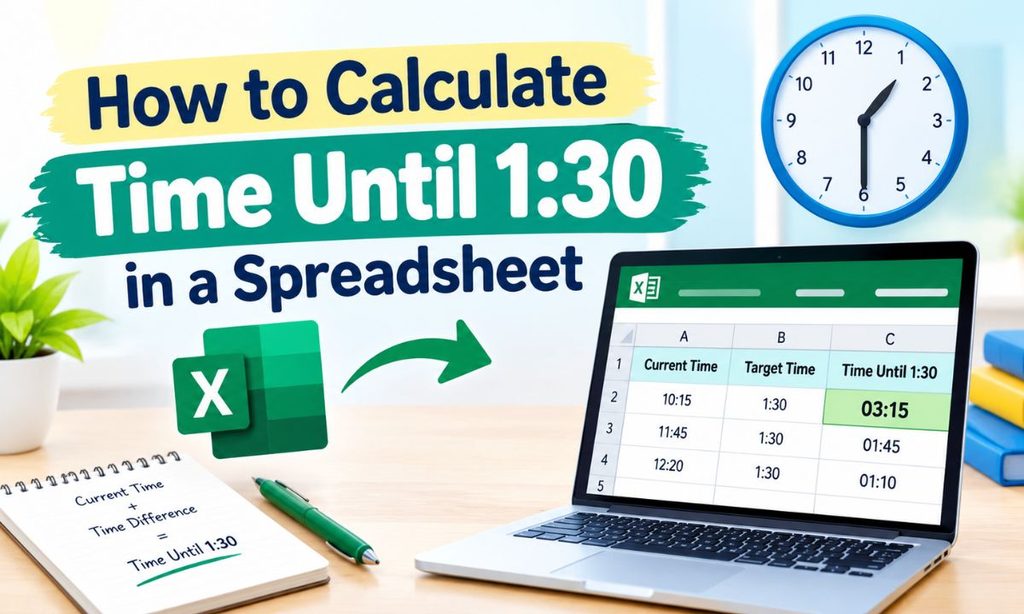
A spreadsheet can count down to 1:30 PM automatically. This helps if you build schedules, shift plans, or deadlines.
In Excel or Google Sheets, use a formula like this:
=MOD(TIME(13,30,0) – MOD(NOW(),1), 1)
Format the result cell as time ([h]:mm). The MOD function wraps the answer past midnight, so it always returns the positive gap to the next 1:30 PM. For 1:30 AM, change the hour from 13 to 1.
1:30 in Different Time Zones
The same moment shows a different clock time in every time zone. Always state the zone when you schedule something for 1:30.
The chart below uses standard-time offsets from UTC. Daylight saving time moves some of these by one hour during part of the year, so check your local rules.
| City or region | UTC offset (standard) | Local time when it is 1:30 PM UTC |
| Los Angeles (PST) | UTC−8 | 5:30 AM |
| Denver (MST) | UTC−7 | 6:30 AM |
| Chicago (CST) | UTC−6 | 7:30 AM |
| New York (EST) | UTC−5 | 8:30 AM |
| London (GMT) | UTC+0 | 1:30 PM |
| Berlin (CET) | UTC+1 | 2:30 PM |
| Dubai (GST) | UTC+4 | 5:30 PM |
| India (IST) | UTC+5:30 | 7:00 PM |
| Singapore (SGT) | UTC+8 | 9:30 PM |
| Tokyo (JST) | UTC+9 | 10:30 PM |
A few habits prevent confusion on remote teams:
- Write the zone every time, such as “1:30 PM EST.”
- Better still, add UTC or a calendar invite that converts automatically.
- Use the 24-hour format for international travel and logistics.
- Check daylight saving dates, because countries change their clocks on different days.
A 1:30 PM call in New York is 10:30 AM in Los Angeles during winter. Mixing up those zones is one of the most common causes of missed meetings.
Why People Search “How Long Until 1:30”
People search this phrase because 1:30 is a common anchor time for meetings, school, travel, and routines. Here are the typical situations:
- Work meetings and calls. 1:30 PM often follows the lunch hour, so many calls start then.
- School schedules. Afternoon classes, early dismissals, and pickup windows often land near 1:30 PM.
- Appointments. Medical, dental, and service appointments often use half-hour slots.
- Travel. Flights, trains, and check-ins can fall at 1:30 AM or 1:30 PM.
- Gaming and live events. Streams, releases, and online events usually announce a start time in a specific zone.
- Shift work. Night and swing shifts can start or end around 1:30 AM or 1:30 PM.
- Deadlines. Submission cut-offs sometimes sit at 1:30 PM so reviewers can process work in the afternoon.
In each case, the person wants a trustworthy countdown they can act on right now.
Plan Your Time Before 1:30: Practical Tips
A realistic countdown includes preparation time, not just the clock gap. If a meeting starts at 1:30 PM, your useful working time ends earlier.
Try these habits:
- Subtract your buffer. Take 5 to 10 minutes for travel, setup, or logging in. A 1:30 PM meeting needs you ready by 1:20 to 1:25.
- Work in blocks. If you have 90 minutes left, three 25-minute focus sessions with short breaks fit neatly.
- Set two alarms. One alarm at the “start getting ready” point and one at the actual deadline.
- Use the 15-minute rule. At 15 minutes before 1:30, stop starting new tasks and finish what is open.
- Plan food and water earlier. Eating before 1:30 PM avoids a mid-afternoon dip in focus.
- Confirm the zone. If anyone on the call is in another city, double-check the time conversion once.
These steps turn a simple subtraction into a plan you can actually follow.
Common Mistakes When Counting Down to 1:30
Most countdown errors come from AM/PM confusion, minute subtraction, or ignoring midnight. Watch for these:
- Mixing AM and PM. The gap between 11:00 AM and 1:30 PM is 2 hours 30 minutes, not 14 hours 30 minutes.
- Forgetting that 12 is a special hour. 12:00 PM is noon, and 12:00 AM is midnight.
- Subtracting minutes incorrectly. From 10:50 to 1:30 is not “3 hours 20 minutes minus something.” Use the hop method: 10 minutes to 11:00, then 2 hours 30 minutes to 1:30 PM, for 2 hours 40 minutes.
- Treating 100 minutes like an hour. Time uses base 60, so 1 hour 40 minutes is 100 minutes, not 1.40 hours.
- Ignoring daylight saving changes. On the days clocks change, a countdown can be an hour longer or shorter than the clock math suggests.
- Skipping the time zone. A time without a zone is incomplete in any shared schedule.
Best Tools for a 1:30 Countdown
A live timer is the most accurate way to count down because it updates every second. These tools work well:
| Tool | Best for | Notes |
| Phone timer or alarm | Everyday use | Works offline and runs in the background |
| Voice assistant | Hands-free checks | Ask for the time left or set a timer |
| Online countdown page | Seeing hours, minutes, and seconds live | Needs a browser tab |
| Calendar reminders | Meetings and appointments | Can alert you 5, 10, or 15 minutes early |
| Spreadsheet formula | Schedules and shift plans | Recalculates automatically |
| Smartwatch | Quick glances | Haptic alerts help during meetings |
For one-off questions, a phone timer is usually enough. For team schedules, calendar invites with built-in time zone handling work better.
Read More: How Long Until 3:25? Easy Countdown Math, Charts, and Quick Answers
Frequently Asked Questions
How long until 1:30 PM?
The time left until 1:30 PM equals 13:30 minus your current time on the 24-hour clock. At 12:30 PM, the answer is exactly one hour.
How long until 1:30 AM?
The time left until 1:30 AM equals 01:30 minus your current time, adding 24 hours if 1:30 AM is tomorrow. At 11:30 PM, the answer is two hours.
How do I calculate how long until 1:30?
Convert both times to the 24-hour clock, subtract the current time from 1:30, and add 24 hours if the result is negative. For example, 9:47 AM to 1:30 PM is 3 hours 43 minutes.
What is 1:30 PM in 24-hour time?
1:30 PM is 13:30 in 24-hour time and 1330 in military time. It falls 810 minutes after midnight.
What is 1:30 AM in 24-hour time?
1:30 AM is 01:30 in 24-hour time and 0130 in military time. It falls 90 minutes after midnight.
How many minutes are in 1 hour 30 minutes?
One hour and 30 minutes equals 90 minutes. That is also 5,400 seconds or 1.5 hours.
How long is it from 12:00 PM to 1:30 PM?
It is exactly 1 hour and 30 minutes from 12:00 PM (noon) to 1:30 PM. That equals 90 minutes.
Conclusion
Working out how long until 1:30 takes less than a minute once you have a method. Decide whether you mean AM or PM, convert both times to the 24-hour clock, subtract, and add 24 hours if the answer comes out negative. For quick checks, the hop method (minutes to the next hour, then whole hours, then the final 30 minutes) is the fastest way to do it in your head.
Remember what the clock leaves out: preparation time, other time zones, and midnight crossovers. Give yourself a 5 to 10 minute buffer before any 1:30 commitment. When people in different cities are involved, write the time zone next to the time. Do those two things and you will rarely be caught off guard.

Barak is a passionate writer who explores name meanings, origins, symbolism, and trends. He creates clear, engaging content that helps readers discover the stories behind names.