
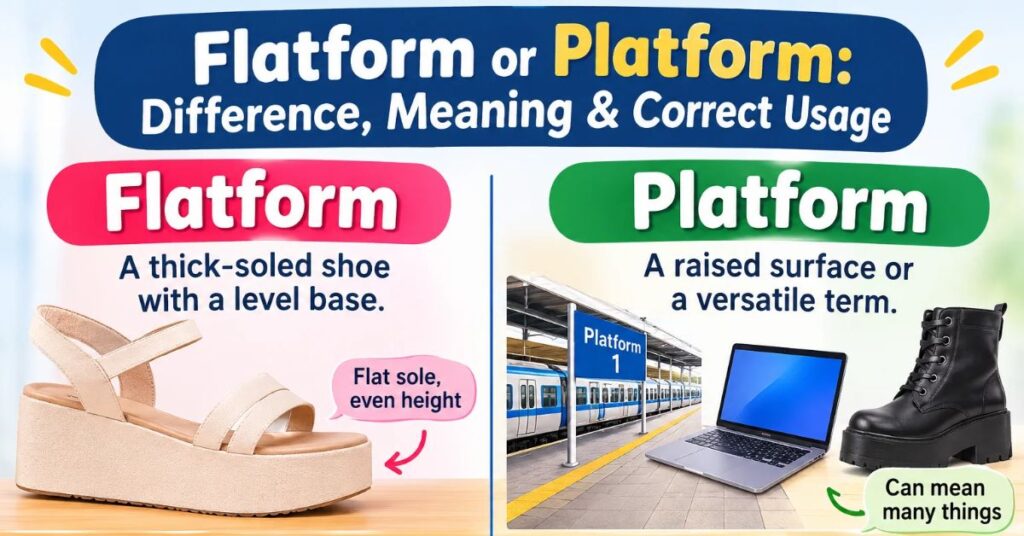
Have you ever seen the words platform and flatform and wondered whether they mean the same thing? You’re not alone. These two words look almost identical, but they describe different things. One has several meanings in everyday English, while the other belongs mainly to the fashion world. Choosing the wrong one can change the meaning of your sentence, especially when you’re discussing shoes, technology, or transportation.
Understanding flatform or platform becomes easier once you know how each word works. Platform can describe a raised surface, a digital service, or a place where train passengers wait. Flatform, however, refers to footwear with a thick, relatively flat sole. This guide explains their meanings, differences, pronunciation, and correct usage. You’ll also find practical examples, common mistakes, and simple tricks to help you remember which word to use.
Quick Answer: Flatform or Platform
The main difference between platform and flatform comes down to their meanings and everyday uses. Although they look similar, you cannot freely replace one with the other.
- Flatform: A fashion term for shoes with a thick sole that stays relatively level from heel to toe.
- Platform: A common English word that describes a raised surface, digital system, train station area, or type of footwear.
For example, you might say:
- We waited for the train on Platform 3.
- She wore black flatform sandals to the party.
The first sentence describes a transportation area. The second refers to a particular shoe style.
Remember that both spellings are correct. Your choice depends on what you’re describing.
Flatform or Platform Comparison Table
A side-by-side comparison makes the difference easier to understand. Both words exist in English, but their meanings, popularity, and contexts vary.
| Feature | Flatform | Platform |
|---|---|---|
| Real English word | Yes | Yes |
| Main meaning | A footwear style | A raised surface or supporting system |
| Common usage | Fashion and footwear | Everyday English |
| Technology meaning | No | Yes |
| Transportation meaning | No | Yes |
| Shoe-related meaning | Yes | Yes |
| Popularity | Less common | Very common |
| Sole design | Thick and relatively level | Can have different shapes and heel heights |
| Typical context | Fashion discussions | Technology, business, transportation, and fashion |
The biggest distinction is their scope. Platform has several meanings across different industries. Flatform has a much narrower meaning and usually appears in discussions about shoes.
If you’re writing about software, trains, or online services, choose platform. When describing thick, level-soled footwear, flatform is the better choice.
Which Is Correct: Flatform or Platform?
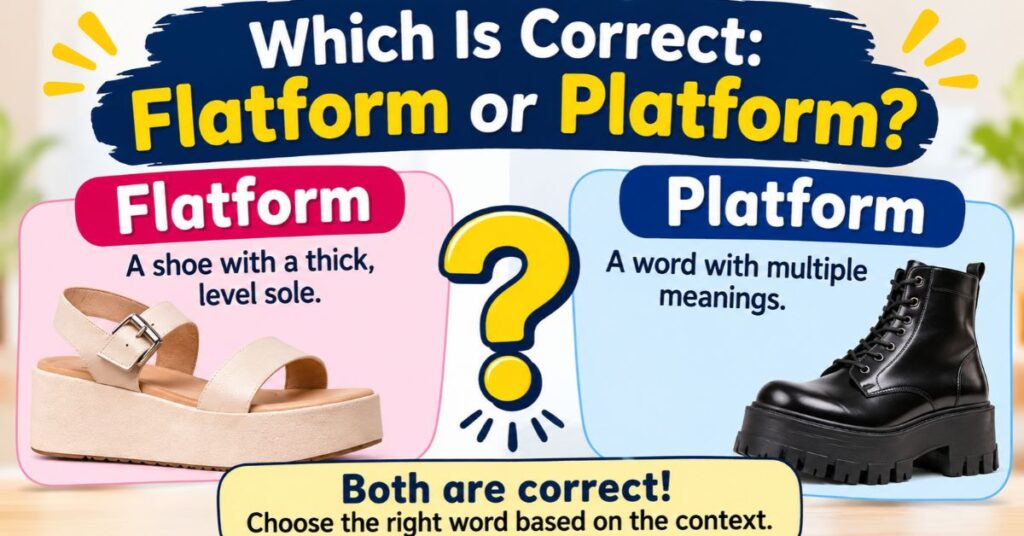
Both words are correct, so neither spelling is automatically wrong. The right choice depends on the subject of your sentence.
Use platform when discussing:
- Technology and software systems.
- Train stations and transportation.
- Social media websites and applications.
- Raised stages or supporting surfaces.
- General platform footwear.
Use flatform when discussing shoes with thick soles that maintain a relatively consistent height from front to back.
For example, a company might introduce a new online platform. However, a fashion store might advertise its latest collection of flatform sneakers.
The important thing is to understand the context before choosing a spelling.
Is Flatform a Real Word?
Yes, flatform is a real English word used in fashion and footwear. It describes shoes with thick soles that remain relatively level from the heel to the toe.
Fashion retailers and footwear brands use this term when describing sandals, boots, and sneakers with a flat, elevated base.
For example, a product description might say that a pair of flatform sandals offers extra height without a steep heel.
Although flatform isn’t as common as platform, that doesn’t make it incorrect. It serves a specific purpose in fashion vocabulary.
Is Platform the Correct Spelling?
Yes, platform is the standard spelling of the general English word. It has a long history of use in everyday communication, technology, transportation, and business.
You should use platform when referring to a digital service, railway area, raised stage, or traditional platform shoe.
For example:
- The company developed a new learning platform.
- Passengers waited on the train platform.
- She bought a pair of platform boots.
However, platform isn’t always the right word for level-soled footwear. In that situation, flatform may describe the design more accurately.
What Does Platform Mean?
Platform is a versatile English noun with several meanings. Its exact definition changes depending on the situation.
Generally, it describes a raised surface, a supporting structure, or a system that allows people and services to operate.
You’ll encounter the word in many areas, including:
- Transportation and railway stations.
- Technology and software development.
- Social media and online communication.
- Business and public discussions.
- Fashion and footwear.
For example, a speaker might stand on a raised platform during an event. Meanwhile, a software developer might build an application for a digital platform.
The word also appears in political discussions, where a platform describes the policies and ideas supported by a political party or candidate.
Platform in Transportation
In transportation, a platform is a designated area where passengers wait to board or leave a train.
You can find railway platforms at train stations, subway stations, and metro stops. Each platform may serve a particular route or direction.
For example:
- The train arrived at Platform 4.
- Please stand behind the yellow safety line.
- Passengers waited on the platform for their morning train.
Railway platforms help organize passenger movement and make boarding safer. Station signs usually display platform numbers so travelers can find the correct departure area.
In this context, platform has nothing to do with fashion or footwear. It simply identifies a specific transportation area.
Platform in Technology
In technology, a platform is a digital system or environment that supports software, applications, and other services.
It provides the tools and structure that allow users or developers to perform different tasks.
Common examples include:
- Android as a mobile operating system platform.
- Windows as a software environment.
- E-commerce platforms that support online shopping.
- Cloud platforms that provide computing services.
- Learning platforms that host educational materials.
Consider this sentence: The company launched a new software platform for small businesses.
Here, platform describes a digital system rather than a physical surface. It can support different applications, users, and business activities.
This meaning is common in professional conversations and technology-related writing.
Platform in Social Media
A social media platform is a website or application where people create, share, and interact with content.
These platforms help users communicate, publish updates, watch videos, and connect with communities.
Popular examples include:
- Instagram for photos, videos, and stories.
- Facebook for social networking and community groups.
- TikTok for short-form videos.
- LinkedIn for professional networking.
- YouTube for video publishing and streaming.
For example, you might say, Instagram is a popular social media platform for creators and businesses.
Companies also use digital platforms to promote products, reach customers, and build their online presence.
In this context, platform describes an online service rather than a type of shoe.
Platform Shoes Meaning
Platform shoes are footwear with thick soles that raise the foot above the ground. Their designs can include flat fronts, elevated heels, or noticeable differences in height between the heel and toe.
Unlike flatforms, traditional platform shoes don’t always maintain an even sole thickness.
Common styles include:
- Platform boots.
- Platform sandals.
- Platform sneakers.
- Platform heels.
- Platform dress shoes.
These shoes have appeared in different fashion periods, including the 1970s. Today, designers continue to use platform soles in casual and formal footwear.
For example, someone might wear platform boots to add height to an outfit.
The term describes the elevated sole design, not necessarily a flat shape.
What Does Flatform Mean?
A flatform is a type of footwear with a thick sole that remains relatively level from front to back.
The word combines the ideas of flatness and platform-style height. It describes shoes that provide extra height without the traditional slope of many high-heeled shoes.
Unlike ordinary flat shoes, flatforms have a noticeably thick base. However, their heel and front sections usually maintain a similar height.
You can find this design in several footwear styles, including sandals, sneakers, and boots.
For example, a pair of flatform sandals might give you extra height while keeping your foot in a more level position.
Flatform is mainly a fashion-related term. You wouldn’t normally use it to describe a website, train station, or software system.
Flatform Shoes Explained
Flatform shoes combine an elevated sole with a relatively even shape. Their design makes them different from both ordinary flats and traditional platform heels.
The sole usually has a similar thickness beneath the heel and forefoot. This creates a flatter profile from the side.
Common types include:
- Flatform sandals: Open footwear with a thick, level base.
- Flatform sneakers: Casual shoes with chunky, relatively flat soles.
- Flatform boots: Boots featuring an elevated and even sole.
- Flatform slip-ons: Easy-to-wear shoes with a thick base.
Imagine comparing two pairs of shoes. One has a thick front and an even thicker heel. The other maintains almost the same sole height throughout.
The second design is a typical example of flatform footwear.
Why Flatforms Became Popular
Flatforms became popular because they combine added height with a relatively level sole design. They offer a different look from traditional heels and ordinary flat shoes.
Their bold shape also makes them useful for creating modern fashion outfits.
Several factors contribute to their popularity:
- Extra height: Their thick soles add visible height.
- Distinctive appearance: Chunky soles create a noticeable fashion statement.
- Versatile styles: You can find them in sandals, sneakers, and boots.
- Casual appeal: Many designs work with everyday clothing.
- Fashion variety: Different colors and materials suit different personal styles.
However, comfort depends on the shoe’s fit, weight, construction, and sole flexibility. A thick sole doesn’t automatically make every pair comfortable.
Platform vs Flatform: Key Differences
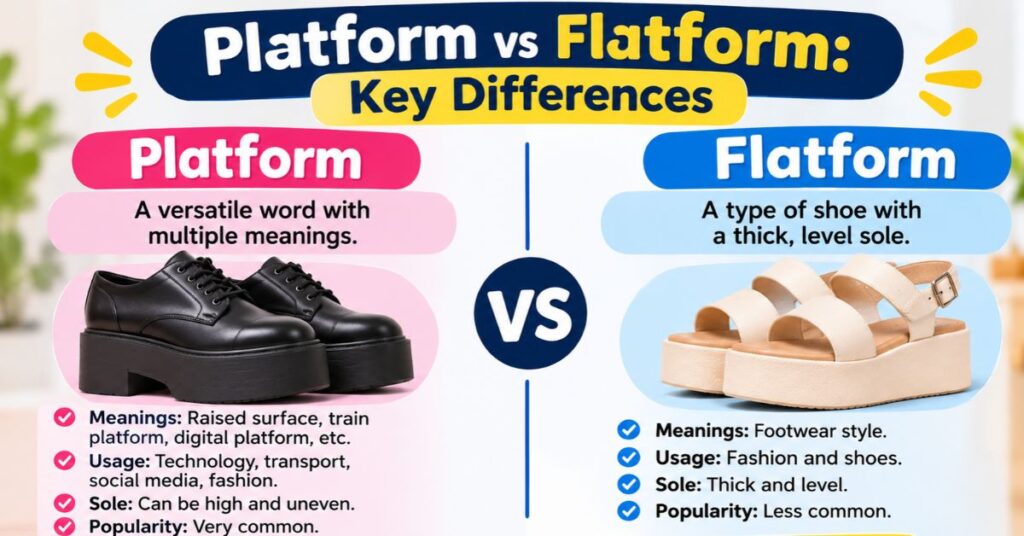
Although platform and flatform share similar spelling, their meanings and uses are quite different. Understanding a few basic differences will help you choose the right word.
Meaning
Platform has several meanings across different subjects. It can describe a raised surface, railway area, technology system, or footwear design.
Flatform has a more specific meaning. It refers to shoes with a thick, relatively level sole.
For example:
- The speaker stood on a platform.
- She purchased new flatform sandals.
The first example describes a raised surface. The second identifies a particular footwear style.
Usage
Platform appears in everyday English across many industries. You can use it in conversations about business, transportation, technology, social media, and fashion.
Flatform appears mainly in fashion-related discussions.
For instance, a teacher might use an online learning platform to share lessons. A fashion blogger might recommend flatform sneakers for a casual outfit.
Their usage depends on the subject. Replacing one with the other can make a sentence confusing or incorrect.
Context
Context determines which word makes sense.
Use platform when discussing:
- Digital services.
- Train stations.
- Raised stages.
- Business systems.
- General platform footwear.
Use flatform when describing:
- Thick, level-soled sandals.
- Elevated sneakers with flat soles.
- Boots with consistent sole thickness.
- Other similar footwear designs.
If your sentence discusses technology or transportation, flatform won’t fit. When the subject is a specific shoe design, it may be the more accurate choice.
Popularity
Platform is much more common in everyday English because people use it across numerous subjects.
You’ll encounter it in news articles, business reports, technology guides, transportation announcements, and ordinary conversations.
Flatform is less common because it belongs mainly to the fashion and footwear vocabulary.
This difference in popularity doesn’t mean one word is more correct than the other. Both serve different purposes.
Think of platform as a general-purpose word and flatform as a specialized fashion term.
Why People Confuse Platform and Flatform
People often confuse these words because their spelling and appearance are remarkably similar. Both contain the letters form at the end, making them easy to mix up.
There are several reasons behind this confusion:
- Similar spelling: Both words have nearly identical letter patterns.
- Shared fashion context: Both can appear in discussions about footwear.
- Unfamiliar vocabulary: Many people know platform but haven’t encountered flatform before.
- Pronunciation similarities: Their sounds are close enough to cause confusion during quick conversations.
- Limited usage: Flatform appears less frequently in everyday writing.
Another reason is that platform shoes and flatform shoes both feature thick soles. However, their designs aren’t necessarily identical.
Similar confusion happens with other English word pairs, such as Tweek vs Tweak and Moment vs Momment.
The easiest solution is to focus on the meaning instead of judging the spelling alone.
Pronunciation Guide
Pronunciation can help you recognize the difference between platform and flatform. Both words contain two syllables and share a similar ending.
However, their opening sounds are different.
Platform
The word platform is pronounced PLAT-form.
It has two syllables:
- Plat
- Form
The first part sounds like the beginning of the word flat, but starts with a P.
You can hear this pronunciation in everyday phrases such as train platform, digital platform, and platform shoes.
Example: We arrived early and waited on the platform.
When speaking, place a little emphasis on the first syllable.
Flatform
The word flatform is pronounced FLAT-form.
It also has two syllables:
- Flat
- Form
The first part sounds like the word flat. This makes the pronunciation easier to remember because flatform describes footwear with a relatively level sole.
Example: She wore flatform sandals during her summer vacation.
Listen for the initial FL sound. It helps distinguish flatform from platform during conversation.
Platform vs Flatform Examples in Sentences
Examples make unfamiliar words easier to understand. The following sentences show how platform and flatform work in everyday communication.
Platform Examples
Here are some practical examples of platform used in different contexts:
- The train will arrive at Platform 2 in five minutes.
- Our company uses a digital platform to manage customer accounts.
- Instagram is a popular platform for sharing photographs.
- The speaker stepped onto the platform before beginning her presentation.
- Android provides a platform for running mobile applications.
- The business launched a new online shopping platform.
- Passengers should remain behind the yellow line on the platform.
- The political candidate explained her platform during the campaign.
- She bought a pair of black platform boots.
- The school introduced a learning platform for students.
Notice how the meaning changes with each situation. Platform can describe a physical place, digital system, public position, or footwear style.
Flatform Examples
Now look at how flatform appears in fashion-related sentences:
- She bought black flatform sandals for her summer vacation.
- Flatform sneakers look great with casual jeans.
- The store displayed several colorful flatform shoes.
- My sister prefers flatform boots over high heels.
- These flatform sandals add height without a steep heel.
- The fashion collection includes leather flatform slip-ons.
- She paired her summer dress with white flatform footwear.
- Flatform sneakers have become a popular casual style.
- The designer introduced a new range of flatform sandals.
- I chose flatform shoes for their bold and modern appearance.
Each example describes footwear with a thick, relatively level sole.
Common Mistakes to Avoid
Because the words look similar, writers sometimes use them incorrectly. Knowing the most common mistakes can help you avoid awkward sentences.
Mistake 1: Using Flatform for Technology
Flatform doesn’t describe a digital system or software service. Platform is the correct word in technology-related sentences.
Incorrect: The company launched a new flatform for online learning.
Correct: The company launched a new platform for online learning.
Remember that websites, applications, operating systems, and digital services use the word platform.
Mistake 2: Assuming Flatform Is a Misspelling
Some people believe flatform is simply an incorrect spelling of platform. That’s not true.
Incorrect: Flatform is not a real English word.
Correct: Flatform is a recognized footwear term.
Fashion brands use this word to describe shoes with thick, relatively level soles.
Don’t automatically correct flatform to platform when reading a fashion product description. The original spelling may be intentional.
Mistake 3: Using Platform When Referring to Flatform Shoes
Platform can describe many types of elevated footwear. However, flatform is more specific when the shoe has a relatively even sole.
Less precise: She bought a pair of platform sandals with level soles.
More specific: She bought a pair of flatform sandals.
The second sentence communicates the footwear design more clearly.
Remember that not every platform shoe is a flatform. Their sole shapes can differ significantly.
Easy Trick to Remember the Difference
You don’t need to memorize complicated grammar rules to understand these words. A simple memory trick can help you choose the correct spelling whenever you write or speak.
Focus on the first part of each word. It gives you a useful clue about its meaning.
Flatform = Flat + Platform
Think of flatform as a combination of flat and platform.
The word begins with flat, which reminds you of its relatively level sole design.
Remember these points:
- Flatform means a footwear style.
- It has a thick sole.
- The sole stays relatively level from heel to toe.
- It commonly describes sandals, sneakers, and boots.
For example, when someone mentions flatform sandals, imagine sandals with a thick but nearly even base.
This small association makes the word easier to remember.
Platform = Many Meanings
Think of platform as a general English word with several meanings.
It can describe a raised surface, transportation area, technology system, or online service.
A quick memory list includes:
- Train platform: Where passengers wait.
- Digital platform: A system that supports online services.
- Social media platform: A place to share content.
- Raised platform: An elevated physical surface.
- Platform shoes: Footwear with thick soles.
Whenever you’re discussing something beyond the specific flatform shoe style, platform may be the correct choice.
Frequently Asked Questions
Is flatform a real word?
Yes. Flatform is a recognized fashion term for shoes with thick soles that remain relatively level from heel to toe.
Which is correct, platform or flatform?
Both are correct. Platform has several meanings, while flatform specifically describes a type of thick-soled footwear.
What is a platform shoe?
A platform shoe features a thick sole that raises the foot. Its heel and front sections may have different heights.
What is a flatform shoe?
A flatform shoe has a thick, relatively level sole that maintains similar height beneath the heel and forefoot.
Can platform refer to technology?
Yes. Platform commonly describes digital systems, software environments, operating systems, and online services that support applications and users.
Why do people write flatform instead of platform?
People use flatform to describe a specific shoe style. Its name combines flat and platform to suggest its level sole design.
Final Verdict
Platform and flatform may look similar, but they serve different purposes in English. Platform is a common word with several meanings. It describes raised surfaces, train station areas, digital systems, social media services, and different footwear styles. Flatform has a narrower meaning and specifically refers to shoes with thick, relatively level soles. Both spellings are correct when you use them in the right context. The easiest way to remember the difference is to connect flatform with flat-soled footwear and platform with its broader meanings.
Whenever you’re unsure about flatform or platform, look at what your sentence describes. Choose platform for technology, transportation, and general uses. Choose flatform when discussing the specific shoe design. A little attention to context can make your writing clearer and more accurate. Remember, the right word makes all the difference.

Abu Bakar is an experienced content writer and website administrator with 4 years of experience in creating informative content about meanings, text, and general topics. He focuses on delivering clear, accurate, and reader-friendly information that helps visitors find exactly what they are looking for.