Have you ever paused while writing a sentence because you weren’t sure whether well deserved needs a hyphen? You’re not alone. This small punctuation choice confuses many English learners and even experienced writers. Both spellings are correct, but the right form depends on how you use the phrase. A simple grammar rule can help you choose the correct version every time.
In everyday writing, you might use this expression when someone earns an award, receives praise, or enjoys a relaxing break after hard work. However, its grammatical position changes the spelling. This guide explains the difference between well deserved and well-deserved with clear definitions, practical examples, and easy grammar tips. You’ll also learn when to use a hyphen, avoid common mistakes, and write more confidently in American English.
Quick Answer: Well Deserved or Well-Deserved?
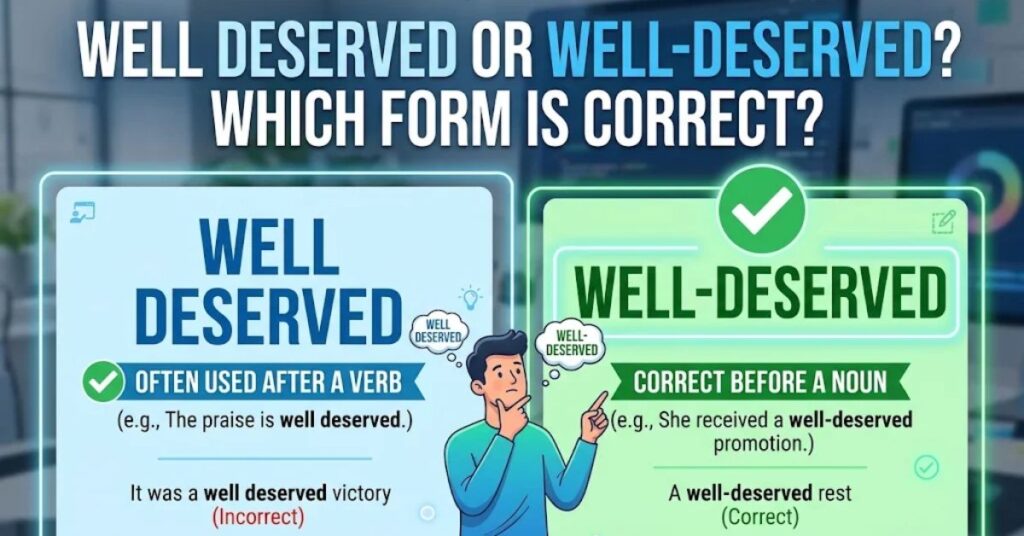
Both forms are correct, but they serve different grammatical purposes. The main difference depends on where the expression appears in your sentence.
Use well-deserved with a hyphen when it comes directly before a noun and describes it.
- She received a well-deserved award.
- He enjoyed a well-deserved vacation.
Use well deserved without a hyphen when it follows a linking verb and describes the subject.
- The award was well deserved.
- His promotion is well deserved.
Remember this simple rule: use a hyphen before a noun and usually remove it after a linking verb. This approach follows standard English hyphenation conventions and makes your sentences easier to understand.
Short Answer
The correct form depends on sentence structure:
- Well-deserved: Before a noun, as in a well-deserved reward.
- Well deserved: After a linking verb, as in the reward was well deserved.
Both expressions communicate that someone earned something fairly through effort or achievement.
Featured Snippet Answer
Well-deserved uses a hyphen when it acts as a compound adjective before a noun, such as a well-deserved promotion. Well deserved appears without a hyphen when it follows a linking verb, such as the promotion was well deserved. Both forms are grammatically correct. Choose the spelling based on the phrase’s position and function in your sentence.
What Does Well-Deserved Mean?
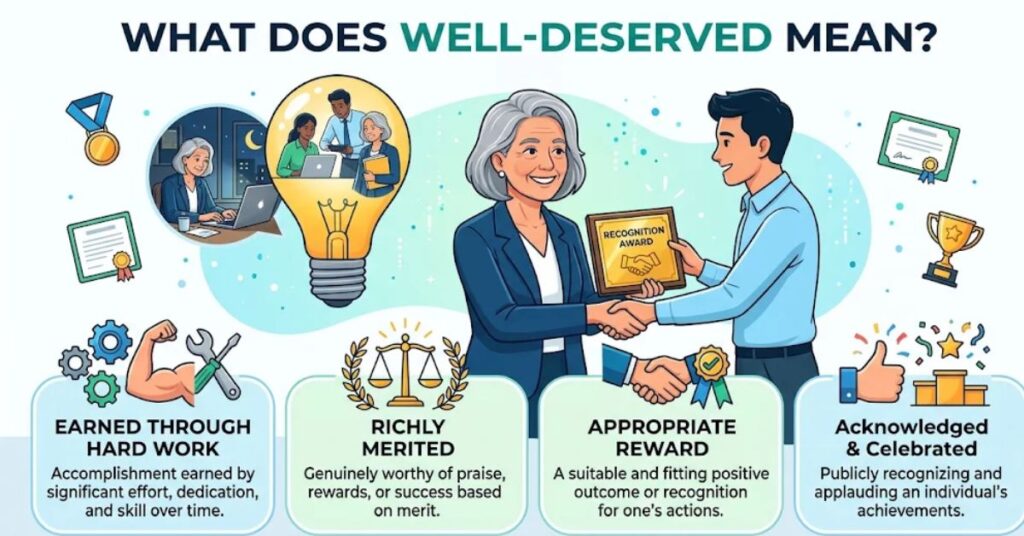
Well-deserved means something has been fairly earned through hard work, dedication, achievement, or good behavior. It describes a reward, experience, or recognition that someone genuinely deserves.
For example, imagine an employee who spends several years improving a company’s performance. When that employee finally receives a promotion, you might call it a well-deserved promotion.
The expression commonly describes:
- Awards and honors
- Professional promotions
- Public recognition
- Praise and compliments
- Personal achievements
- Relaxing breaks and vacations
- Business success
- Academic accomplishments
The phrase carries a positive meaning. It suggests that someone has worked for something and earned it through genuine effort rather than receiving it without reason.
Examples
Here are some examples that show how the expression works:
- Sarah received a well-deserved award for her community service.
- The athlete earned a well-deserved medal.
- After months of hard work, the vacation was well deserved.
- The volunteers finally received well-deserved recognition.
- His success was well deserved after years of dedication.
Well Deserved vs Well-Deserved: Key Difference
The difference between these expressions isn’t their meaning. Both communicate that something is deserved or earned fairly.
The distinction comes from grammar. Well-deserved works as a compound adjective when it appears before a noun. Well deserved generally appears after a linking verb and describes the subject.
Consider these two sentences:
- She received a well-deserved promotion.
- Her promotion was well deserved.
Both sentences express the same idea. However, the first uses a compound modifier before the noun promotion. The second uses an adjective phrase after the linking verb was.
Understanding this difference helps you avoid unnecessary hyphens and improve your writing.
Comparison Table
| Feature | Well-Deserved | Well Deserved |
|---|---|---|
| Spelling | With a hyphen | Without a hyphen |
| Grammar | Compound adjective | Predicate adjective phrase |
| Position | Before a noun | Usually after a verb |
| Function | Modifies a noun | Describes the subject |
| Example | A well-deserved award | The award was well deserved |
Side-by-Side Examples
Comparing similar sentences makes the rule easier to remember.
| Before a noun | After a verb |
|---|---|
| A well-deserved promotion | The promotion was well deserved |
| A well-deserved compliment | The compliment was well deserved |
| A well-deserved break | The break was well deserved |
| A well-deserved victory | The victory was well deserved |
| A well-deserved reward | The reward was well deserved |
Notice how the meaning stays almost identical. Only the grammatical position changes the hyphenation.
When to Use Well-Deserved
Use well-deserved when two words work together as a compound adjective before a noun. The hyphen connects them and shows readers that they form one descriptive expression.
For example:
- She celebrated a well-deserved achievement.
- The manager announced a well-deserved promotion.
- They enjoyed a well-deserved holiday.
- He received a well-deserved compliment.
In each sentence, the expression directly describes the noun that follows it.
This rule also applies to formal documents, workplace emails, blog posts, academic writing, and everyday communication. Whenever the phrase appears before a noun as one combined modifier, the hyphen generally improves clarity.
Before a Noun
The easiest way to identify this form is to look at the word immediately following the expression.
If a noun comes next and well-deserved describes it, use the hyphen.
Examples include:
- A well-deserved award
- A well-deserved opportunity
- A well-deserved promotion
- A well-deserved victory
- A well-deserved compliment
Imagine writing about a teacher who helped struggling students throughout the year. You could say, She received a well-deserved recognition for her dedication.
The phrase describes recognition directly, so the hyphenated form is appropriate.
Compound Adjective Rule
A compound adjective contains two or more words that work together to describe one noun.
English often uses hyphens to connect these words when they appear before the noun.
Consider these examples:
- Well-deserved award
- High-quality service
- Long-term strategy
- Well-known author
- Full-time employee
Without a hyphen, readers might briefly misunderstand how the words relate to each other.
However, hyphens aren’t required in every compound adjective. Some expressions have established open or closed forms. Always consider the grammatical function and standard usage.
When to Use Well Deserved
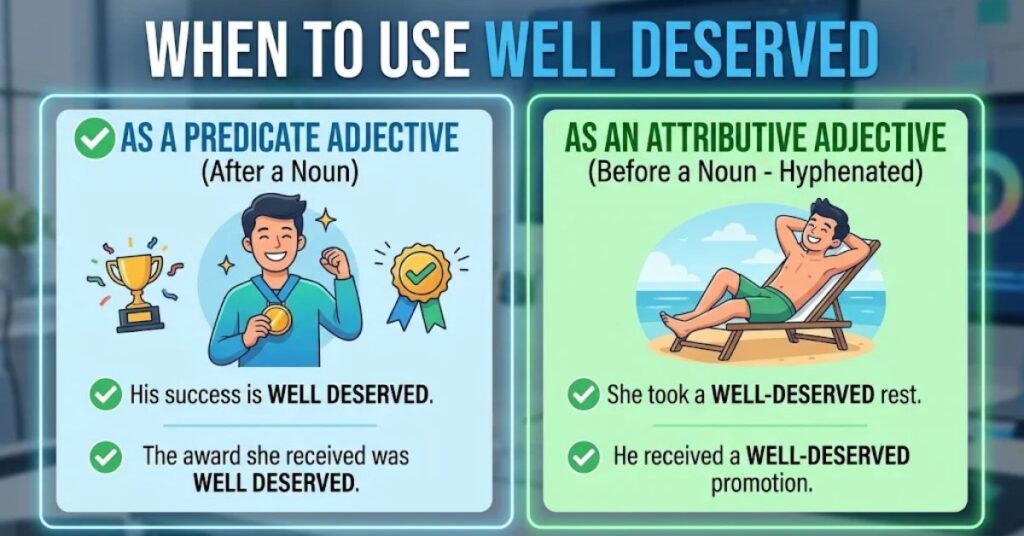
Use well deserved without a hyphen when the phrase appears after a linking verb and describes the subject.
Common linking verbs include:
- Is
- Was
- Were
- Seems
- Feels
- Became
For example, you might write:
- Her promotion was well deserved.
- Their victory was well deserved.
- The praise is well deserved.
- His success seems well deserved.
Here, the expression doesn’t directly modify a noun that follows it. Instead, it describes the subject of the sentence.
This grammatical structure is common in conversations, professional writing, reviews, and personal messages.
Examples
These sentences demonstrate the correct unhyphenated form:
- Your recent achievement was well deserved.
- The employee’s bonus was well deserved.
- Her scholarship was well deserved.
- The team’s success is well deserved.
- Their recognition seems well deserved.
You could also use this expression in everyday conversation.
For example:
Person A: Did you hear that Emma received the employee award?
Person B: Yes! Her recognition was well deserved.
Predicate Adjective Rule
A predicate adjective describes the subject of a sentence through a linking verb.
For example:
The award was well deserved.
In this sentence:
- The award is the subject.
- Was is the linking verb.
- Well deserved describes the subject.
Because the expression follows the linking verb, you generally don’t need a hyphen.
This is why writing the award was well deserved is the preferred form in standard edited English.
Read More :Flatform or Platform: Difference, Meaning & Correct Usage
Why Is Well-Deserved Hyphenated?
The hyphen connects well and deserved when they work together as one compound adjective.
It tells readers to understand both words as a single descriptive unit rather than separate modifiers.
For example, in a well-deserved award, the expression describes the award as something fairly earned.
Hyphens also improve readability in other compound modifiers. You’ll see the same pattern in expressions such as well-known actor and high-quality product.
However, the hyphen isn’t necessary in every grammatical position. When the expression follows a linking verb, standard usage generally leaves it out.
Example
Compare these sentences:
Correct: She received a well-deserved reward.
Correct: The reward was well deserved.
Less preferred: She received a well deserved reward.
Less preferred: The reward was well-deserved.
The first two examples follow the usual compound adjective and predicate adjective patterns.
Compound Modifiers Explained
A compound modifier is a group of words that functions as one adjective. It describes a noun and provides additional information about it.
Hyphens often connect compound modifiers when they appear immediately before the noun.
Here are some common examples:
| Compound modifier | Example |
|---|---|
| Well-deserved | A well-deserved award |
| Well-known | A well-known writer |
| High-quality | A high-quality product |
| Long-term | A long-term plan |
| Full-time | A full-time employee |
| Last-minute | A last-minute decision |
These expressions help readers understand how multiple words work together.
However, compound modifiers don’t always need hyphens. For example, many style conventions leave familiar expressions open when they appear after linking verbs.
The important thing is to understand the phrase’s function rather than memorize every expression separately.
Examples of Well-Deserved in Sentences
The hyphenated expression appears in many situations. You can use it to describe professional achievements, personal rewards, public recognition, and enjoyable experiences.
Awards
Use well-deserved when someone earns an award through outstanding performance or dedication.
- The teacher received a well-deserved award for helping students.
- Her well-deserved honor celebrated years of community service.
- The scientist earned a well-deserved achievement award.
Promotions
A promotion often recognizes an employee’s hard work and professional growth.
- James celebrated his well-deserved promotion.
- The company announced a well-deserved advancement for its manager.
- She finally received a well-deserved leadership position.
Recognition
Recognition means acknowledging someone’s contribution or achievement.
- The volunteers received well-deserved recognition.
- Her research earned well-deserved appreciation.
- The organization gained well-deserved attention for its work.
Success
Success can result from years of preparation, patience, and dedication.
- The business achieved well-deserved success.
- Their well-deserved victory surprised nobody.
- She celebrated a well-deserved career achievement.
Compliments
A compliment expresses appreciation for someone’s qualities, work, or behavior.
- He received a well-deserved compliment from his manager.
- Her well-deserved praise encouraged the entire team.
- The artist appreciated the well-deserved appreciation.
Breaks
People also use this expression when someone takes time to relax after working hard.
- Everyone enjoyed a well-deserved break after the project.
- She planned a well-deserved vacation.
- The exhausted team took a well-deserved afternoon off.
Examples of Well Deserved in Sentences
The unhyphenated expression commonly appears after linking verbs. You can use it in professional, academic, and personal situations.
Workplace Examples
Workplace conversations often involve promotions, bonuses, achievements, and employee recognition.
Here are some natural examples:
- His promotion was well deserved.
- The employee’s bonus was well deserved.
- Her leadership recognition was well deserved.
- Their professional success was well deserved.
Academic Examples
Students and teachers also receive recognition for their dedication and performance.
Consider these examples:
- Her scholarship was well deserved.
- The student’s academic award was well deserved.
- The teacher’s appreciation was well deserved.
- His graduation achievement was well deserved.
Everyday Examples
You don’t need a formal situation to use this expression. It works naturally in daily conversations.
- Your happiness is well deserved.
- The compliment was well deserved.
- Their victory was well deserved.
- That relaxing weekend was well deserved.
Common Grammar Mistakes With Well Deserved
Even though the rule is straightforward, writers sometimes place hyphens incorrectly. Understanding these common mistakes will help you edit your sentences more accurately.
Mistake #1: Missing the Hyphen Before a Noun
When the expression works as a compound adjective before a noun, leaving out the hyphen is generally incorrect in standard edited writing.
Incorrect: She received a well deserved award.
Correct: She received a well-deserved award.
The hyphen connects both words and shows that they describe the award together.
Mistake #2: Overusing the Hyphen
Some writers add a hyphen even when the expression follows a linking verb.
Less preferred: The promotion was well-deserved.
Preferred: The promotion was well deserved.
The unhyphenated version follows the usual predicate adjective pattern.
Mistake #3: Inconsistent Usage
Another mistake happens when writers use different spellings for the same grammatical structure.
Inconsistent: He earned a well deserved promotion because it was well-deserved.
Better: He earned a well-deserved promotion because it was well deserved.
Check the position of the expression whenever you proofread your work.
Similar Hyphenated Expressions
Learning similar expressions can make compound adjective rules easier to understand. These examples follow a pattern you’ll often see in English writing.
Well-Known
Use a hyphen before a noun:
- She interviewed a well-known author.
- He is a well-known musician.
The second sentence generally doesn’t need a hyphen because the expression follows a linking verb.
Long-Term
Use the hyphen when describing a noun:
- They developed a long-term strategy.
- Their plan is long term.
High-Quality
Use a hyphen before the noun:
- We purchased a high-quality product.
- The product is high quality.
Full-Time
Use the hyphen when the expression modifies a noun:
- She accepted a full-time position.
- He works full time.
These examples demonstrate how hyphenation can change depending on grammatical position.
Well Deserved Award Meaning
A well-deserved award is an honor someone earns through genuine effort, achievement, talent, or contribution.
The expression suggests that the recipient deserves recognition because of something meaningful they’ve accomplished.
For example, an employee might spend years helping a company grow. When the company finally recognizes that person’s dedication with an award, you could describe it as a well-deserved award.
The phrase commonly appears in:
- Employee appreciation messages
- Award announcements
- Graduation speeches
- Sports celebrations
- Professional achievements
- Community recognition events
It communicates fairness and appreciation. The award isn’t simply a gift. It’s recognition of something the recipient has earned.
Example
The nurse received a well-deserved award for providing excellent patient care throughout her career.
Here, well-deserved describes the award and explains why the recognition feels fair.
Well-Deserved Recognition
Well-deserved recognition means acknowledgment or appreciation that someone earns through hard work, dedication, or meaningful contributions.
People often use this expression when discussing employees, volunteers, teachers, researchers, and community leaders.
For example:
- The volunteers finally received well-deserved recognition for their efforts.
- The researcher gained well-deserved recognition after the discovery.
- Her dedication earned well-deserved recognition from the entire organization.
Recognition doesn’t always involve a trophy or formal award. Sometimes, a sincere thank-you or public acknowledgment can mean just as much.
The expression highlights the connection between someone’s contribution and the appreciation they receive.
Well-Deserved Success
Well-deserved success refers to positive results earned through effort, patience, dedication, and skill.
It suggests that someone has worked toward a goal and achieved something meaningful.
For example, a small business owner might spend years improving products and building customer relationships. When the business finally becomes successful, people may describe that achievement as well-deserved success.
Here are additional examples:
- Her well-deserved success inspired young entrepreneurs.
- The company achieved well-deserved success in a competitive market.
- After years of training, his success was well deserved.
The expression adds a sense of fairness and appreciation to someone’s achievement.
US vs UK English Usage
American and British English generally follow the same hyphenation principle for this expression.
Both varieties distinguish between compound adjectives before nouns and descriptive phrases after linking verbs.
American English
American English generally uses the hyphen before a noun and omits it after a linking verb.
Examples:
- She received a well-deserved achievement award.
- His promotion was well deserved.
- They enjoyed a well-deserved vacation.
American spelling usually prefers honor instead of the British honour.
British English
British English follows the same general grammatical pattern.
Examples:
- She received a well-deserved honour.
- The recognition was well deserved.
- He enjoyed a well-deserved holiday.
The main difference in these examples involves regional vocabulary and spelling, not the hyphenation rule.
Editor and Style Guide Recommendations
Professional editors generally consider grammatical function when deciding whether to use a hyphen.
The goal is to make sentences clear, consistent, and easy to read. The following approach works well in most everyday and professional writing.
Before the Noun
Use the hyphen when well-deserved directly modifies a noun.
Examples:
- A well-deserved reward
- A well-deserved compliment
- A well-deserved promotion
- A well-deserved achievement
This structure treats both words as one compound adjective.
After the Verb
Usually leave out the hyphen when the expression follows a linking verb.
Examples:
- The reward was well deserved.
- Her compliment was well deserved.
- His achievement is well deserved.
This structure uses the expression to describe the subject rather than modify a following noun.
Memory Tricks to Remember the Rule
You don’t need to memorize complicated grammar definitions to use this expression correctly. A few simple tricks can help you remember the difference.
1. Before-Noun Test
Check whether a noun comes immediately after the expression.
If well-deserved describes that noun, include the hyphen.
Example: A well-deserved promotion.
2. Swap Test
Compare the expression with other compound adjectives.
For example:
- A well-known actor
- A high-quality product
- A long-term plan
These expressions use hyphens before nouns. Well-deserved follows the same general pattern.
3. Read-Aloud Method
Read your sentence aloud and notice how the expression connects to the surrounding words.
For example:
- She received a well-deserved award.
- The award was well deserved.
Reading both sentences makes the grammatical difference easier to recognize.
4. Think “One Idea”
Remember that the hyphen connects two words into one descriptive idea.
In a well-deserved reward, well and deserved work together to describe the reward. After a linking verb, that compound modifier structure is no longer needed.
Common Questions About Well-Deserved
Is there a hyphen in well-deserved?
Yes. Use a hyphen when well-deserved appears before a noun and functions as a compound adjective.
Is well deserved grammatically correct?
Yes. Well deserved is correct when it follows a linking verb and describes the subject.
What does well-deserved mean?
It means something has been fairly earned through genuine effort, achievement, dedication, or good work.
Can I write well deserved without a hyphen?
Yes. You can write well deserved without a hyphen when it follows a linking verb, such as was.
When should well-deserved be hyphenated?
Use the hyphen when the expression directly modifies a noun, such as a well-deserved award or promotion.
What is the difference between well deserved and well-deserved?
Well-deserved generally appears before a noun as a compound adjective. Well deserved usually follows a linking verb.
Final Verdict
So, which spelling should you choose? The answer depends on how you build your sentence. Both forms are correct, but they serve different grammatical purposes. Use well-deserved when it comes before a noun and describes it directly. For example, she received a well-deserved award. However, remove the hyphen when the expression follows a linking verb. You can write the award was well deserved. This simple distinction makes your writing clearer and helps you avoid common punctuation mistakes.
The next time you use this expression, take a moment to check the words around it. Is it describing a noun that follows? Add the hyphen. Does it appear after a linking verb? Leave the hyphen out. With a little practice, choosing between well deserved and well-deserved will become second nature. Good grammar doesn’t have to feel complicated. Sometimes, understanding one small rule makes a big difference in how confidently you communicate.

Abu Bakar is an experienced content writer and website administrator with 4 years of experience in creating informative content about meanings, text, and general topics. He focuses on delivering clear, accurate, and reader-friendly information that helps visitors find exactly what they are looking for.