
If you have been scrolling through TikTok comments, Snapchat streaks, or group chats lately, there is a good chance you have seen the letters “ONB” pop up somewhere. At first glance, it looks like just another random internet abbreviation, but it actually carries a pretty clear meaning once you know the context. This guide breaks down what ONB means, where it came from, how people use it today, and how you can reply to it without feeling lost.
ONB Meaning in Text – Quick Definition
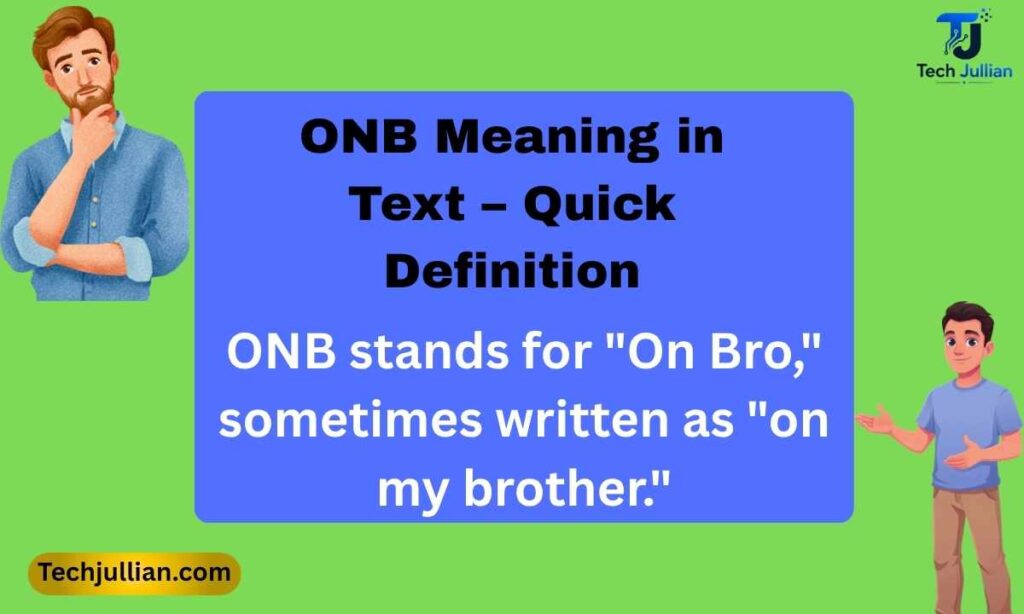
ONB stands for “On Bro,” sometimes written as “on my brother.” It is a slang phrase used to back up a statement and prove that someone is being completely honest. Think of it as a digital version of “I swear,” “on God,” or “for real.” When someone adds ONB to a sentence, they are telling you they mean every word.
Simple examples:
- “That movie was actually scary, ONB.”
- “I’m not lying, he really did that. ONB.”
- “This burger place is the best in town, ONB.”
In each case, ONB simply strengthens the statement and tells the other person to trust what was said.
Origin and Background of ONB
ONB did not start in a dictionary or a classroom. It grew out of everyday slang where people swear on things they care about, like “on my mom,” “on my life,” or “on my brother.” These phrases have been used in casual speech for years as a way to add weight to a statement.
As texting and social media took over daily communication, people began shortening longer phrases to save time and characters. “On my brother” naturally turned into “on bro,” which then got compressed further into the three letter acronym ONB.
How it evolved:
- Started as a spoken phrase to swear honesty among friends
- Became popular in music, especially hip hop and urban slang
- Shifted into texting and comment sections as a quick abbreviation
- Spread across platforms like Snapchat, TikTok, and Instagram through younger users
Real-Life Conversations Using ONB
Seeing ONB in an actual conversation makes its meaning much easier to understand. Here are a few everyday examples across different apps.
WhatsApp Conversation Example
Friend 1: “Bro I finished the whole project last night.”
Friend 2: “No way, really?”
Friend 1: “ONB, I stayed up till 3am for it.”
Instagram DM Example
User 1: “Did you actually meet him at the concert?”
User 2: “ONB, we even took a photo together.”
Text Message Example
“I’m telling you, that test was so hard. ONB, I almost cried.”
TikTok Comment Example
“This recipe actually works, ONB. I tried it last night and it was perfect.”
Read More: 35+ Formal Ways to Say “Thank You for Reaching Out to Me”
Emotional and Psychological Meaning
ONB is more than just a random abbreviation. The way people use it says a lot about how they communicate and connect with others online.
1. Desire to Be Believed
When text messages lack tone of voice and facial expressions, people often feel like their words might not be taken seriously. ONB acts as a small verbal stamp that says, “I really mean this.”
2. Emotional Connection
Using ONB often signals closeness. People tend to use it more with friends, siblings, or partners than with strangers, since it carries a casual and personal tone.
3. Need for Emphasis
Sometimes a sentence on its own feels flat. Adding ONB gives it extra punch, similar to raising your voice slightly when speaking in person.
4. Identity and Belonging
Using current slang like ONB can also be a way of fitting into a certain group, especially among younger users who want their messages to sound natural and relatable.
Usage in Different Contexts
ONB does not mean the same thing in every situation. Where and how it is used can change how it lands.
Social Media
On platforms like TikTok, Instagram, and Snapchat, ONB is extremely common in comments and replies, usually to confirm that something shown in a video or photo is real.
Friends and Relationships
Among close friends, ONB is often used playfully to back up jokes, plans, or stories, and helps keep conversations light and fun.
Professional Settings
ONB has no place in work emails, official messages, or business chats. It is purely informal and can come across as unprofessional in serious settings.
Casual vs Serious Tone
ONB can shift between casual and slightly serious depending on the sentence around it. A joke followed by ONB still feels playful, while a personal confession followed by ONB feels more sincere.
Common Misunderstandings
Like most slang, ONB is often misread by people who are not familiar with how it is used.
Mistake 1: Thinking it means “Okay No Problem”
Some people assume ONB is a polite agreement phrase, but it actually has nothing to do with saying yes or okay.
Mistake 2: Using it in formal emails
Because it looks short and harmless, some users mistakenly type ONB in work related messages, which can confuse colleagues or seem too casual.
Mistake 3: Thinking it always means promise
ONB usually emphasizes truth rather than making a future commitment, so it is closer to “I swear this is true” than “I promise I will do this.”
Mistake 4: Overusing it
Adding ONB to every single sentence can make messages feel exaggerated and reduce its impact, since constant emphasis starts to lose meaning.
Comparison Table
Here is how ONB compares to similar texting abbreviations people often confuse it with.
| Abbreviation | Full Meaning | Main Use | Tone |
| ONB | On Bro | Backing up a statement as truthful | Casual, friendly |
| ONG | On God | Swearing something is true | Casual, strong emphasis |
| FR | For Real | Confirming something is genuine | Casual |
| NO CAP | Not lying | Saying there is no exaggeration | Casual, playful |
| ON LIFE | On my life | Strong personal oath | Serious, emotional |
Variations of ONB (Types and Meanings)
ONB often appears with extra words attached to make the emphasis even stronger.
1. ON BRO
The full version of ONB, used the same way but written out completely for extra clarity.
2. ONB FR
Combines ONB with “for real” to double down on honesty, often used when someone seems doubtful.
3. ONB I SWEAR
Adds a direct oath after ONB, making the statement feel more urgent or important.
4. ONB NO CAP
Mixes ONB with “no cap” to strongly insist that there is zero exaggeration involved.
5. ONB BRO
A repeated form used mainly for emphasis or as a casual habit in fast typing.
6. ONB THIS TRUE
Used when someone wants to confirm that a claim or rumor is actually accurate.
7. ONB LIFE
A more serious version, often used when talking about something emotionally important.
8. ONB I PROMISE
Leans slightly toward a future commitment rather than just confirming a fact.
9. ONB TRUST ME
Used to ask for belief while reassuring the other person that the information is reliable.
10. ONB FOR REAL
Another emphasis combo, almost identical to ONB FR but written out fully.
How to Respond When Someone Uses ONB
Replying to ONB depends on the tone of the conversation and how well you know the person.
Casual Replies
“Okay I believe you” or “Alright bro, noted.”
Funny Replies
“ONB? Sounds like a movie plot” or “Bro really swore on his own name.”
Mature Replies
“Got it, thanks for clarifying” or “Okay, that makes sense now.”
Respectful Replies
“I trust you” or “Appreciate you for being honest about it.”
Confident Replies
“Yeah I figured, ONB too” or “Same here, no doubt about it.”
Regional and Cultural Usage
ONB is mainly an internet trend, but its popularity varies slightly across regions.
Western Culture
In the United States and the United Kingdom, ONB is widely used among teenagers and young adults, especially in casual texting and social media comments.
Asian Culture
In many Asian countries, English based slang like ONB is mostly used by younger, internet active users who mix it with their local language in chats.
Middle Eastern Culture
ONB appears mostly in English language conversations among younger users, often alongside other social media slang picked up from global trends.
Global Internet Culture
Since slang spreads quickly through short videos and comment sections, ONB has become recognizable across many countries, even where English is not the first language.
Real-Life Experience Insight
After observing how ONB is used across group chats, comment sections, and social media replies, one thing stands out clearly: it almost always shows up when someone feels their words alone are not enough. Whether it is confirming a funny story, defending a claim, or reacting to something surprising, ONB acts like a small trust signal. People rarely overthink it while typing, which is exactly why it feels so natural in everyday conversations between friends.
When You Should Use ONB
ONB works best in relaxed, friendly conversations where tone is informal. It fits well when:
- Confirming something surprising or unexpected
- Backing up a personal story or claim
- Reacting to content on social media
- Chatting casually with friends or close contacts
Avoid using it in emails, official messages, or conversations with people you do not know well.
Why ONB Became So Popular
ONB became popular because it is short, easy to type, and instantly understood by people active on social media. It fits perfectly into fast paced digital conversations where speed and emphasis matter more than full sentences. As short form videos and quick comments became the norm, abbreviations like ONB spread rapidly because they capture emotion and honesty in just three letters.
Conclusion
ONB might look confusing the first time you see it, but its meaning is actually simple once explained. Standing for “On Bro,” it is a casual way to emphasize honesty, similar to saying “I swear” or “for real.” It works best in friendly, informal conversations across texting apps and social media, but should be avoided in professional settings.
Now that you know what ONB means, where it comes from, and how to use or respond to it, you can read it confidently the next time it shows up in your chats.